
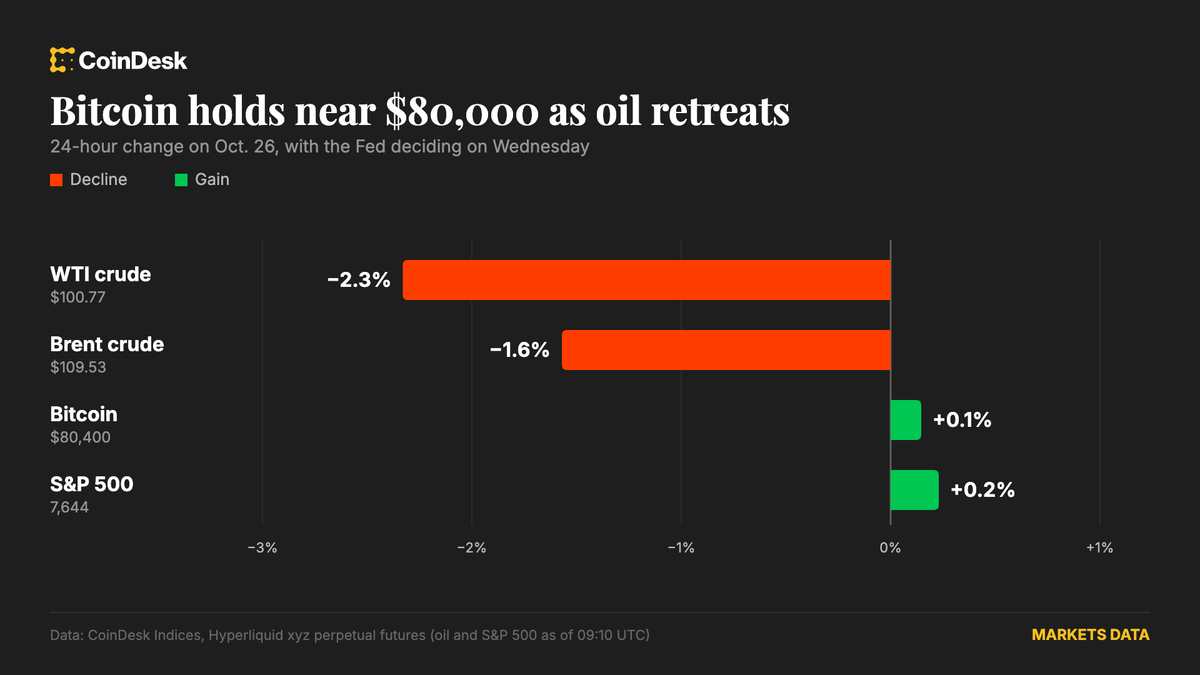
Bitcoin shows resilience, holding near $80,290 despite significant spot ETF outflows and a complex macro outlook dominated by Fed decisions and geopolitical tensions.
⚡ Key Takeaways
- Bitcoin's price remains stable near $80,290, defying $772 million in spot ETF outflows over two days.
- Arthur Hayes' Maelstrom fund liquidated 6,400 ETH, citing escalating macro and geopolitical risks.
- The upcoming Fed decision on interest rates and ongoing Middle East developments are key market drivers.
- Oil prices are retreating, and traditional markets are showing mixed signals, impacting crypto sentiment.
| Asset | Price | 24h | Market Cap |
|---|---|---|---|
| Bitcoin (BTC) | $80,290.00 | +0.01% | $1.61T |
| Ethereum (ETH) | $2,329.00 | +0.04% | $284.52B |
Market data as of Oct 26, 2026 12:29 UTC (CoinGecko).
📑 Table of Contents
Bitcoin (BTC) is demonstrating remarkable stability, currently trading at $80,290.00 on October 26, 2026, holding firm despite significant spot exchange-traded fund (ETF) outflows and a complex global macro outlook. This resilience comes as investors grapple with looming Federal Reserve decisions and persistent geopolitical tensions, shaping the broader Bitcoin macro outlook.
The leading cryptocurrency's ability to maintain its value near the $80,000 psychological level suggests underlying strength, even as traditional markets react to shifting global dynamics. Ethereum (ETH) has also shown slight positive movement, currently priced at $2,329.00 with a modest +0.04% change over the past 24 hours, mirroring Bitcoin's steady performance.
What Happened in the Markets
Over the past 24 hours, Bitcoin has largely stabilized around the $80,000 mark after a brief dip below $79,300 during the Asian trading session. This stability is notable given recent market turbulence in other sectors.
Influential crypto figure Arthur Hayes, co-founder of BitMEX, disclosed that his Maelstrom fund had entirely sold its directional book, including a substantial 6,400 Ethereum. Hayes attributed this significant liquidation to mounting macro and geopolitical risks, signaling a cautious stance from a prominent market participant.
Meanwhile, altcoins presented a mixed picture, with Ethereum posting a minor gain. The broader traditional financial markets also saw varied performance, with S&P 500 index futures rising approximately 0.3% following a selloff in U.S. stocks on Friday.
Navigating Global Headwinds & Investor Sentiment
The crypto market's current trajectory is heavily influenced by a confluence of global macroeconomic and geopolitical factors. Oil prices, a key indicator of global economic health and stability, have been retreating. U.S. crude dropped roughly 2% to trade near $101 a barrel, while Brent crude slipped to around $110.
This decline in oil prices follows developments in the Middle East, including the arrival of Qatari mediators in Tehran and President Donald Trump's statement that a strike would not occur on Sunday, although he maintained the option. Such geopolitical de-escalation can alleviate inflationary pressures and improve overall market sentiment, which indirectly supports risk assets like cryptocurrencies.
Adding to the cautious atmosphere is the impending Federal Reserve interest rate decision, scheduled for Wednesday. The Fed had previously raised rates in September, and market observers, as indicated by the CME’s FedWatch tool, currently see a 90% probability of no change in rates this week. However, the tool also points to an approximately 80% chance of another rate increase in December, keeping investors on edge regarding future monetary policy.
Market Impact & On-Chain Data Signals
Despite Bitcoin's current price resilience at $80,290.00, the spot Bitcoin ETF market has seen significant outflows. Data from Farside Investors reveals $138 million in outflows on Friday alone, contributing to a two-day total exit of $772 million. These outflows suggest that institutional investors may be taking profits or reallocating capital amidst macro uncertainties, yet Bitcoin's price has absorbed this selling pressure with remarkable poise.
The stability of Bitcoin's price in the face of these outflows suggests strong underlying demand from other market segments or long-term holders. Its 24-hour change of +0.01% indicates a tight trading range, with bulls and bears currently balanced. Ethereum, trading at $2,329.00, also shows a modest +0.04% change, reflecting a similar equilibrium.
In a related development, diversified Real World Asset (RWA) stablecoins continue to offer competitive yields, sustaining 5-7% from real credit sources. This contrasts with a compression in crypto funding rates, which have fallen to approximately 4%. Projects like GENIUS are actively pushing yield generation off-chain, contributing to a growing Total Addressable Market (TAM) projected to reach $4 billion within three years. This trend highlights a broader search for sustainable yield in a tightening crypto funding environment.
What to Watch Next
- Federal Reserve Decision: The outcome of the Fed's meeting on Wednesday will be critical, as any unexpected hawkish signals could trigger broader market volatility.
- Geopolitical Developments: Ongoing discussions and events in the Middle East will continue to influence oil prices and global risk sentiment, directly affecting crypto markets.
- Spot Bitcoin ETF Flows: Monitoring daily inflow and outflow data for Bitcoin ETFs will provide insights into institutional investor sentiment and potential selling pressure.
- Key Technical Levels: Traders will be closely watching Bitcoin's ability to hold support around the $79,000 level, with potential resistance forming near $81,500.
- RWA Sector Growth: Continued innovation and adoption within the RWA stablecoin and yield generation space could offer alternative investment avenues for those seeking stable returns.
Bottom Line
Bitcoin's ability to maintain its ground near $80,290.00 amidst a flurry of macro and geopolitical challenges underscores its evolving role as a resilient asset. While significant institutional outflows from spot ETFs indicate some caution, the cryptocurrency's steadfastness suggests robust demand and conviction from a diverse investor base. As the market looks ahead to critical Fed decisions and unfolding global events, Bitcoin's response to these external pressures will be a definitive test of its maturity and stability in a volatile world.
Frequently Asked Questions
Why is Bitcoin's price stable despite ETF outflows?
Bitcoin's stability near $80,290, despite significant spot ETF outflows, suggests strong underlying demand from other market segments, such as retail investors or long-term holders. This absorption of selling pressure indicates a resilient market structure.
How do geopolitical events impact the crypto market?
Geopolitical events, such as those impacting oil prices or global stability, influence investor risk appetite. De-escalation can boost confidence in risk assets like crypto, while increased tensions can lead to a flight to safety, affecting asset prices.
What is Arthur Hayes' Maelstrom fund and why did it sell ETH?
Arthur Hayes' Maelstrom fund is an investment vehicle managed by the influential co-founder of BitMEX. The fund liquidated its entire directional book, including 6,400 ETH, due to concerns over escalating macroeconomic and geopolitical risks, signaling a cautious stance.
📚 Related Reading
Source: CoinDesk
Disclaimer: This article is for informational purposes only and does not constitute financial or investment advice. Cryptocurrencies are highly volatile — always do your own research.



0 تعليقات