
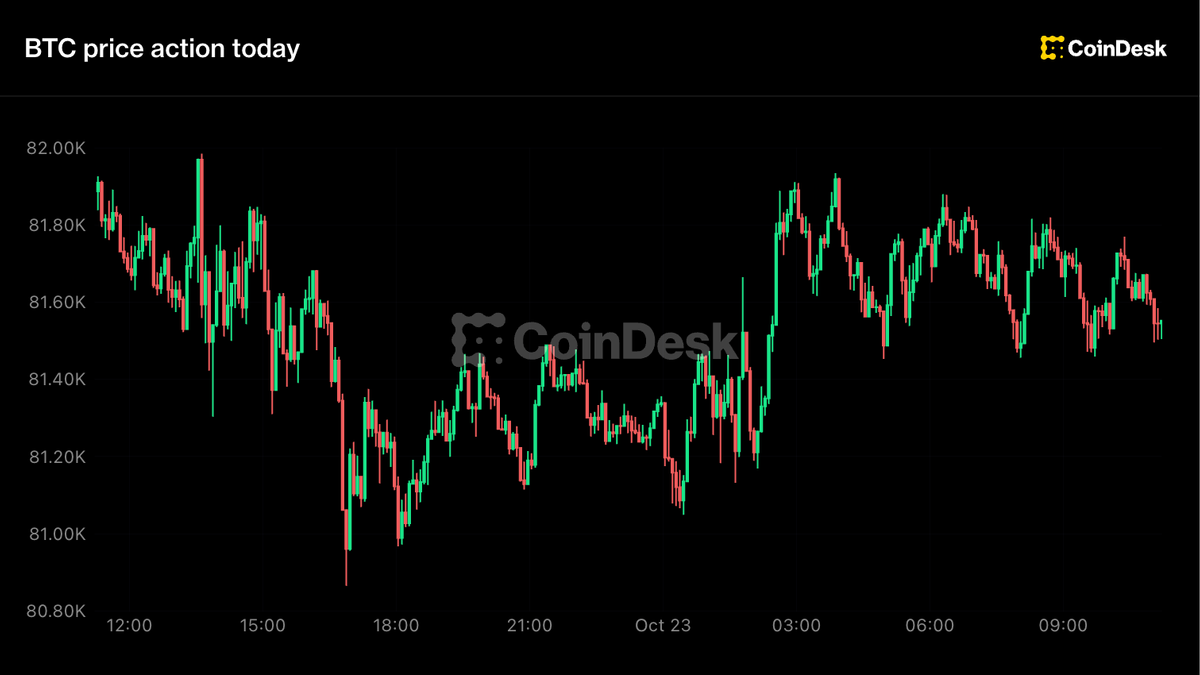
Bitcoin price stability holds above $81,500 today, October 23, 2026, after a volatile week. We examine the macro factors, including oil prices and the upcoming Fed meeting, influencing crypto markets.
⚡ Key Takeaways
- Bitcoin (BTC) has stabilized near $81,562 after experiencing significant $3,000 price swings earlier this week.
- Rising Brent crude oil prices, at a six-month high, are reigniting inflation fears ahead of the critical Fed meeting.
- The Federal Reserve's October 27-28 meeting is the primary macro event dictating short-term market direction.
- Altcoins like Ethereum and Solana saw minor dips, reflecting broader cautious sentiment across the market.
| Asset | Price | 24h | Market Cap |
|---|---|---|---|
| Bitcoin (BTC) | $81,562.00 | -0.43% | $1.64T |
| Ethereum (ETH) | $2,395.14 | -0.31% | $292.56B |
| Solana (SOL) | $103.98 | -0.52% | $61.31B |
Market data as of Oct 23, 2026 11:21 UTC (CoinGecko).
📑 Table of Contents
Bitcoin price stability has emerged this Friday, October 23, 2026, as the leading cryptocurrency holds firm above $81,500 after a week marked by significant volatility and $3,000 price swings. Investors are closely watching macroeconomic signals, particularly escalating oil prices and the looming Federal Reserve meeting, which are shaping sentiment across both traditional and digital asset markets. This current consolidation phase for BTC suggests a period of investor assessment amidst shifting global economic narratives.
What Happened: Bitcoin Finds Stability Above $81,500
After a turbulent week that saw Bitcoin's price fluctuate wildly, the digital asset has found a temporary equilibrium. Currently, Bitcoin (BTC) is trading at $81,562.00, reflecting a slight 24-hour dip of -0.43%. This calm follows a period where BTC briefly lost the crucial $82,500 support level on Thursday, a threshold it had struggled to maintain. The current trading range, confined to less than $1,000, signals a significant reduction in immediate volatility compared to the rapid $3,000 movements observed just days prior.
The broader cryptocurrency market reflects this cautious sentiment. Ethereum (ETH), the second-largest cryptocurrency by market capitalization, is priced at $2,395.14, experiencing a minor 24-hour decline of -0.31%. Similarly, Solana (SOL) has seen a modest dip of -0.52%, bringing its price to $103.98. While some altcoins like BNB and DOGE registered small gains, others such as Monero (XMR) and Zcash (ZEC) gave back part of their earlier advances, underscoring a mixed performance across the altcoin landscape. This subdued activity suggests market participants are pausing, awaiting clearer directional cues from macro indicators.
Macroeconomic Headwinds and Shifting Global Narratives
The current crypto market's cautious stance is deeply intertwined with broader macroeconomic developments. While the "AI rout" that impacted tech stocks and, by extension, risk assets appears to be fading, new concerns are quickly taking its place. The most prominent among these is the resurgence of inflation fears, primarily fueled by a significant climb in oil prices. Brent crude oil, a global benchmark, has touched its highest level since early May, a development that complicates the inflation outlook for central banks worldwide.
This rise in energy costs directly influences consumer prices and production costs, putting pressure on monetary policy decisions. The Federal Reserve's upcoming Federal Open Market Committee (FOMC) meeting, scheduled for October 27-28, is now under intense scrutiny. Investors are eager to gauge the Fed's stance on interest rates and quantitative easing in light of persistent inflationary pressures. Any hawkish signals could lead to a tightening of liquidity, historically a bearish factor for risk assets like cryptocurrencies.
Traditional financial markets are also reacting to these shifts. Nasdaq 100 futures showed little change after the index's worst day since June, indicating a search for stability. An ETF tracking chipmakers edged higher, suggesting some sector-specific resilience, while individual stocks like Meta continued to fall, and SpaceX climbed on reports of new ventures. The U.S. Treasury market saw yields recover some ground after Thursday's haven rally, which had pushed the 10-year yield down significantly. Gold and the U.S. dollar remained relatively flat, reflecting a wait-and-see approach from investors navigating this uncertain economic landscape.
Market Impact and On-Chain Data Insights
Bitcoin's ability to maintain its position above the $81,000 mark, despite losing the immediate $82,500 support, is a critical indicator of underlying demand at this price level. With a market capitalization of $1.64 trillion, Bitcoin's current stability suggests that while upward momentum is stalled, there isn't an immediate capitulation event occurring. Ethereum, with its market cap of $292.56 billion, and Solana, holding $61.31 billion, also reflect this broader market pause rather than a sharp sell-off.
On-chain data, though not showing dramatic shifts, likely indicates a period of consolidation. Analysts at various firms are observing that long-term holders may be accumulating at these levels, viewing the recent dips as buying opportunities, while short-term traders might be taking profits or reducing exposure ahead of potential macro shocks. The slight negative 24-hour changes across major cryptocurrencies suggest a lack of conviction for aggressive moves in either direction, with traders opting for caution. This delicate balance means that any significant news from the Fed or a further escalation in oil prices could quickly tip the scales, leading to renewed volatility. The market is effectively holding its breath, positioned for a reaction rather than proactive movement.
What to Watch Next: Key Catalysts for Crypto Markets
The coming days will be crucial for determining the short-term trajectory of Bitcoin and the wider crypto market. Several key events and indicators demand close attention:
- Federal Reserve FOMC Meeting (October 27-28): The outcome of this meeting, including any statements regarding interest rates, inflation, or future monetary policy, will be the most significant catalyst. A hawkish stance could pressure risk assets.
- Oil Price Movements: Continued upward pressure on Brent crude oil could exacerbate inflation fears, potentially leading to further market caution and a flight from riskier assets.
- Bitcoin Technical Levels: Traders will be closely watching if Bitcoin can reclaim the $82,500 level as resistance or if it finds strong support at $81,000. A break below $81,000 could signal further downside.
- Corporate Earnings Season: Ongoing earnings reports from major tech companies could influence broader stock market sentiment, which often spills over into crypto.
- Geopolitical Developments: Any unexpected global events or shifts in international relations can trigger market uncertainty and impact asset prices.
Bottom Line: Cautious Optimism Amidst Macro Uncertainty
As of October 23, 2026, Bitcoin has demonstrated a commendable degree of price stability, holding above $81,500 after a tumultuous week. This resilience, however, is tempered by a complex macroeconomic backdrop dominated by rising oil prices and the impending Federal Reserve meeting. While the immediate "AI rout" fears have subsided, new inflationary concerns are dictating market sentiment. Investors should remain vigilant, understanding that the current calm may be a precursor to significant movement once the Federal Reserve's intentions become clearer. The ability of Bitcoin to maintain this level amidst such uncertainty will be a key test of its maturity as an asset class.
Frequently Asked Questions
What is driving Bitcoin's current price stability above $81,500?
Bitcoin's current stability is largely due to a temporary pause in volatility after significant price swings. It suggests a balance between buyers and sellers, with investors assessing macroeconomic factors like rising oil prices and the upcoming Federal Reserve meeting before making major moves.
How do rising oil prices affect the crypto market?
Rising oil prices often fuel inflation concerns, which can prompt central banks like the Federal Reserve to adopt a more hawkish monetary policy. This can lead to higher interest rates and a tighter liquidity environment, typically seen as bearish for risk assets such as cryptocurrencies.
What should investors watch for in the coming week regarding Bitcoin's price?
Investors should closely monitor the Federal Reserve's FOMC meeting on October 27-28 for policy statements. Additionally, observe oil price trends and Bitcoin's ability to hold critical technical levels like $81,000 support or reclaim $82,500 resistance.
📚 Related Reading
Source: CoinDesk
Disclaimer: This article is for informational purposes only and does not constitute financial or investment advice. Cryptocurrencies are highly volatile — always do your own research.



0 تعليقات