
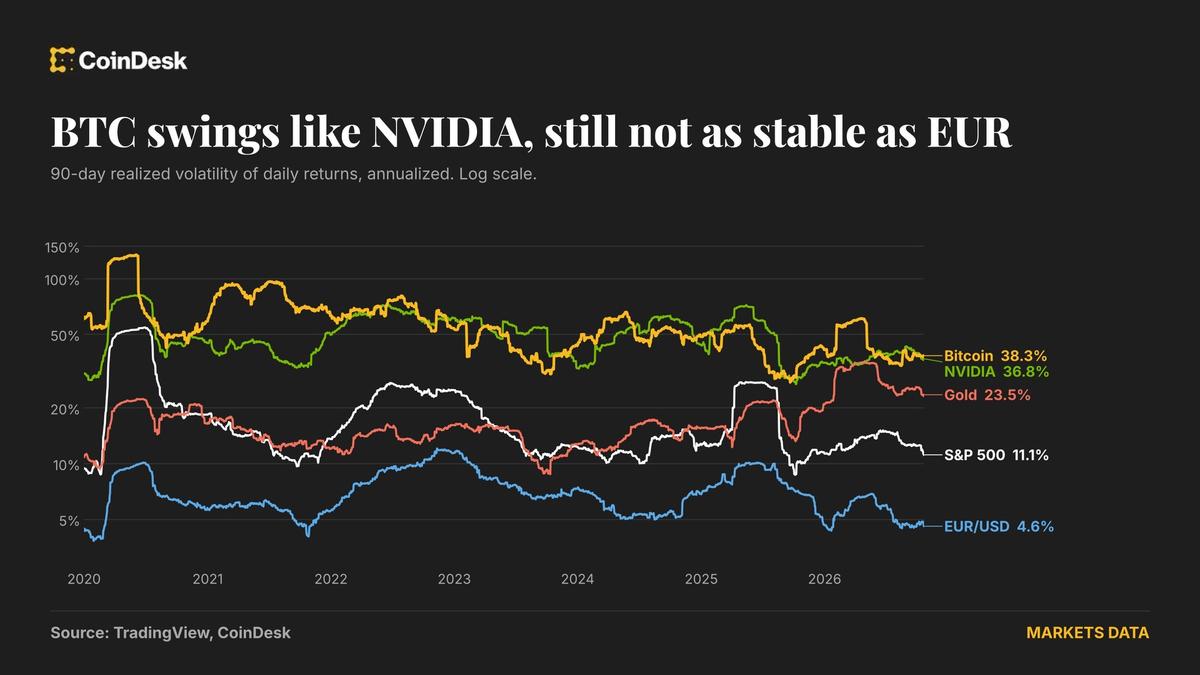
Bitcoin's 90-day realized volatility stands at 38% as of October 24, 2026, matching Nvidia. Discover how BTC's stability compares to the Euro and S&P 500.
⚡ Key Takeaways
- Bitcoin's 90-day realized volatility is 38%, akin to high-growth tech stock Nvidia.
- BTC remains significantly more volatile than traditional assets like gold (23.5%) and the S&P 500 (11%).
- The Euro/USD pair shows remarkable stability at 4.6%, making Bitcoin roughly eight times more turbulent.
- Despite current price fluctuations, Bitcoin's long-term volatility has decreased since 2020 highs.
| Asset | Price | 24h | Market Cap |
|---|---|---|---|
| Bitcoin (BTC) | $80,545.00 | -1.33% | $1.62T |
Market data as of Oct 24, 2026 10:34 UTC (CoinGecko).
📑 Table of Contents
As of October 24, 2026, Bitcoin's 90-day realized volatility has reached approximately 38%, positioning the leading cryptocurrency's price swings on par with semiconductor giant Nvidia. This critical metric, which gauges the magnitude of an asset's price movements over a specific period, reveals a fascinating comparison between the digital asset and traditional financial instruments. While Bitcoin continues to command a significant market presence, currently trading at $80,545.00 with a market capitalization of $1.62T, its stability profile remains a key factor for institutional adoption.
Unpacking Bitcoin's Current Volatility Metrics
Realized volatility is a standard deviation of daily returns, typically annualized, providing a clear picture of an asset's historical price turbulence. A higher percentage indicates more significant price swings and, consequently, a higher perception of risk. Bitcoin's current 90-day realized volatility of 38% places it in a unique category, closely aligning with individual high-growth equities rather than broad market indices or stable currencies.
When benchmarked against traditional assets, the contrast becomes stark. Gold, often considered a safe-haven asset, exhibits a 90-day realized volatility of approximately 23.5%. The S&P 500, representing the broader U.S. stock market, sits at a considerably lower 11%. This means Bitcoin is currently over three times as volatile as the leading stock index, highlighting its distinct risk profile for portfolio managers.
The most striking comparison emerges with the Euro/U.S. Dollar (EUR/USD) exchange rate, the most liquid fiat currency pair globally, which maintains a remarkable 90-day realized volatility of just 4.6%. This figure underscores the immense stability inherent in major fiat currencies, making Bitcoin roughly eight times more turbulent than the world's primary reserve currency pair. Despite its limited supply and decentralized nature, BTC still has significant ground to cover to match the stability of traditional mediums of exchange.
The Journey to Stability: Bitcoin's Volatility History
While Bitcoin's current volatility might seem high compared to traditional assets, historical data reveals a clear trend towards greater stability over the long term. Since January 2020, Bitcoin's 90-day volatility has averaged around 58%, peaking at an astonishing 134% in June 2020 during a period of intense market uncertainty. These historical figures demonstrate a significant reduction in BTC's price swings, reflecting a maturing market and increased institutional participation.
The calmest period for Bitcoin's volatility recorded was in September 2025, when its 90-day reading dropped to 27.5% as prices surged past the $100,000 mark. This trend suggests that while Bitcoin may still experience notable fluctuations, the extreme price swings of its earlier days are becoming less frequent. This gradual normalization of volatility is crucial for attracting and retaining professional investors, who prioritize risk management and predictable asset behavior.
The evolving risk management practices within the crypto space, including the proliferation of sophisticated derivatives and institutional investment products, have contributed to this trend. As more capital flows into regulated and structured crypto offerings, the market's overall resilience and predictability are expected to improve, further narrowing the volatility gap with established asset classes.
Market Impact and Current Bitcoin Performance
Bitcoin's current status, with 90-day realized volatility mirroring a major tech stock like Nvidia, has significant implications for its market perception and investment thesis. On October 24, 2026, Bitcoin is trading at $80,545.00, reflecting a 24-hour change of -1.33%. This daily fluctuation, while notable, falls within the expected range for an asset exhibiting a 38% annualized volatility.
The comparison to Nvidia, a company known for its innovation and rapid growth in the AI sector, suggests that Bitcoin is increasingly viewed through the lens of a high-growth, technology-driven asset rather than a pure currency. This perspective can influence how investors allocate capital, potentially categorizing BTC alongside other disruptive technologies in diversified portfolios. The substantial market cap of $1.62T further solidifies Bitcoin's position as a major global asset, despite its ongoing volatility.
However, the persistent gap in stability between Bitcoin and major fiat currencies or gold means that it is not yet perceived as a primary store of value or medium of exchange by all traditional financial institutions. Its role as a portfolio diversifier is still being debated, with its correlation to other risk assets remaining a key area of research.
What to Watch Next for Bitcoin Stability
- Institutional Inflows and ETF Performance: Continued growth in Bitcoin Spot ETF inflows or outflows will significantly impact market liquidity and price stability.
- Macroeconomic Conditions: Global inflation data, interest rate decisions by central banks, and geopolitical events can influence investor appetite for risk assets like Bitcoin.
- Regulatory Developments: Clearer regulatory frameworks in major economies could reduce uncertainty and foster greater institutional participation, potentially dampening volatility.
- Technological Upgrades: Major protocol upgrades or scaling solutions could enhance Bitcoin's utility and perceived value, affecting its long-term stability.
- Correlation with Traditional Markets: Observe how Bitcoin's volatility correlates with the VIX index and other traditional market fear gauges, especially during periods of broader market stress.
Bottom Line: Bitcoin's Evolving Risk Profile
Bitcoin's 38% realized volatility, placing it alongside high-growth tech stocks, underscores its journey from a niche digital experiment to a significant global asset. While it has made considerable strides in reducing its historical price turbulence, BTC still operates in a different league compared to the stability offered by gold, the S&P 500, or major fiat currencies. For investors, understanding this evolving risk profile is paramount. Bitcoin continues to offer unique opportunities, but its inherent volatility demands a nuanced approach to portfolio construction and risk management as it strives for broader acceptance in the global financial landscape.
Frequently Asked Questions
What is realized volatility in crypto?
Realized volatility measures how much an asset's price has moved over a specific period, typically 30 or 90 days. It's calculated as the standard deviation of daily returns, annualized, to indicate the magnitude of past price swings.
How does Bitcoin's volatility compare to traditional assets?
As of October 2026, Bitcoin's 90-day realized volatility is about 38%, similar to Nvidia. This is significantly higher than gold (23.5%), the S&P 500 (11%), and especially the Euro/USD currency pair (4.6%), which is eight times more stable.
Is Bitcoin becoming more stable over time?
Yes, historical data shows a clear trend of decreasing Bitcoin volatility. Its 90-day volatility has dropped from an average of 58% since 2020 and a peak of 134% in June 2020 to its current 38%, indicating a maturing market and greater institutional involvement.
📚 Related Reading
Source: CoinDesk
Disclaimer: This article is for informational purposes only and does not constitute financial or investment advice. Cryptocurrencies are highly volatile — always do your own research.



0 تعليقات